The silverback gorilla is one of nature’s most awe-inspiring figures—an icon of strength, wisdom, and loyalty. Towering above the rest of the group, the silverback is not just the biggest member of the gorilla family—he is its heart and protector. But what is life really like for a silverback? Let’s journey into the forest to explore the challenges, responsibilities, and rhythms of life for these gentle giants.
What Is a Silverback?
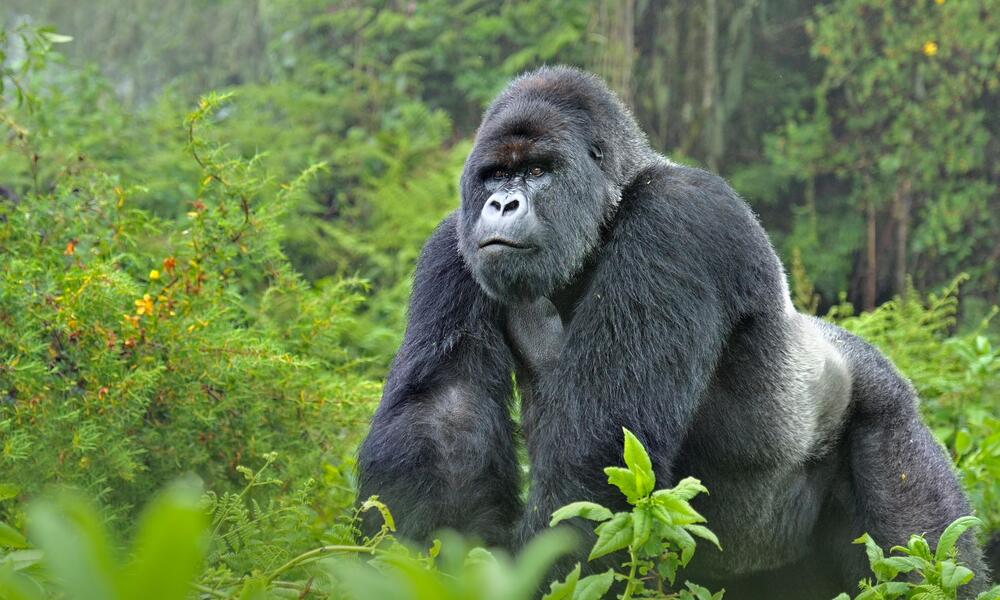
A silverback is an adult male gorilla, typically over 12 years old, named for the distinctive silver-grey saddle of hair that grows on his back as he matures. This isn’t just a change in appearance—it marks his transition into dominance, leadership, and sometimes fatherhood.
While male gorillas all go through a silverback phase if they live long enough, only a few take on the immense responsibility of leading a family group.
Role of a Silverback Gorilla
Power and Responsibility
The silverback is the leader and decision-maker of the gorilla group (known as a troop or family). He guides the group’s movements, protects them from threats, mediates social conflicts, and decides when to eat, travel, or rest.
Despite his commanding presence, the silverback’s leadership is not based on aggression—it is rooted in confidence, wisdom, and emotional intelligence. He builds trust through grooming, play, and reassurance, especially with females and young gorillas.
For example, in Bwindi Impenetrable Forest, the famous silverback Mubare led Uganda’s first habituated gorilla group for years with calm dignity, often intervening gently in squabbles among juveniles and shielding infants from danger.
The Protector of the Family
Silverbacks are fiercely protective. If the group is threatened—whether by a leopard, an unfamiliar gorilla, or a human—the silverback will defend his family, even at great personal risk. He may beat his chest, roar, charge, or stand between the threat and his troop.
In rare cases, this can lead to confrontations with rival males seeking to take over the group. These fights can be intense, as the stakes are high: if a rival wins, he might kill the infants in the group to bring the females back into estrus—a brutal evolutionary strategy known as infanticide.
Thus, the silverback’s role is not just symbolic—it is one of life and death.
Fatherhood and Social Bonds
Though not all gorilla groups have a close paternal system, in many cases, the silverback is the father of the infants and juveniles in the group. He is often seen playing with the young, allowing them to climb on his back, and protecting them with quiet patience.
His presence provides emotional security. Young gorillas often sleep near him at night and follow him closely during the day. His stable leadership gives the entire group a sense of peace and routine.
A well-documented silverback named Titus, studied over decades in Rwanda’s Volcanoes National Park, was known not only for his strong leadership but for the deep emotional bonds he maintained with his group throughout his life.
Silverback Legends of Bwindi Impenetrable Forest

1. Ruhondeza
The Pioneer of Gorilla Tourism in Uganda
Group: Mubare Group
Region: Buhoma
Notable for: Being the first habituated silverback in Uganda
Ruhondeza is a name etched into the history of gorilla conservation in Uganda. As the dominant silverback of the Mubare group, he led the first habituated gorilla family for tourism in Uganda back in 1993.
Ruhondeza was known for his calm and gentle leadership. He maintained peace within the group and was deeply respected by rangers and researchers. As he aged, rival males began challenging his authority. Eventually, a younger silverback took over, and Ruhondeza retreated into a quiet life alone in the forest.
He passed away peacefully in 2012 at a very old age (estimated to be over 50 years). The Uganda Wildlife Authority built a small memorial near where he died—honoring him as a founding father of Uganda’s gorilla tourism.
2. Mishaya
The Warrior Silverback
Group: Formerly Nshongi and Mishaya Group
Region: Rushaga
Notable for: Fierce protector and fighter
Mishaya was a powerful and aggressive silverback known for his courage and territorial dominance. Originally a member of the large Nshongi group, he broke away in 2010 and formed his own family after battling for dominance.
He was famous for often engaging in conflicts with other gorilla families to expand his group. Trackers admired his fearlessness and loyalty. Even after suffering multiple injuries in fights, Mishaya defended his family with unrelenting determination.
Mishaya died in 2014 from a sudden illness, leaving behind a legacy of strength and bold leadership.
3. Rafiki
Group: Nkuringo Group
Region: Nkuringo
Notable for: Beloved silverback tragically killed by poachers
Rafiki was one of the most iconic silverbacks in the Nkuringo sector. Known for his friendly demeanor and calm authority, Rafiki welcomed thousands of tourists into his territory. His name means “friend” in Swahili—a reflection of his personality.
In June 2020, Rafiki was illegally killed by poachers during a hunting expedition. His death sent shockwaves through the conservation community and led to the arrest and conviction of the poachers involved.
Rafiki’s story became a rallying cry for stronger wildlife protection laws and deeper commitment to gorilla conservation in Uganda.
Silverback Legends of Volcanoes National Park
1. Titus
The King of the Volcanoes
Group: Titus Group (originally studied by Dian Fossey)
Region: Karisoke area
Notable for: Longest-studied wild silverback in history
Born during Dian Fossey’s early research in 1974, Titus overcame a traumatic start—his father was killed by poachers, and his family fell apart. Yet he rose to become one of the most dominant and successful silverbacks ever recorded.
He ruled for more than 20 years, sired dozens of offspring, and maintained stability within his group like few others. Researchers described him as a thoughtful and strategic leader who rarely used violence to exert control.
Titus passed away in 2009 of natural causes. He is considered the most legendary silverback in Rwanda’s gorilla history, and his life was featured in the BBC documentary “The Gorilla King.”
2. Cantsbee
Group: Pablo Group
Region: Susa area
Notable for: Record-breaking group leadership and longevity
Cantsbee was born in 1978 and discovered by Dian Fossey herself. He led the massive Pablo group, once the largest known gorilla family in the world (over 60 individuals!). His name came from Fossey’s surprise when she first saw him: “Can’t be!”
Cantsbee was known for his gentle but firm leadership, fathering more than 25 gorillas. He led well into his 30s, mentoring younger males and maintaining unity in a large, complex group.
He died in 2017, likely of old age, after disappearing into the forest—leaving behind a vast legacy of descendants and one of the most studied gorilla families on Earth.
3. Guhonda
The Longest-Reigning Silverback
Group: Sabyinyo Group
Region: Near Kinigi
Notable for: Longevity and leadership stability
Guhonda is a living legend. As of the last updates, he is the oldest known living silverback in Volcanoes National Park, having ruled the Sabyinyo group for over 20 years.
He is famed for his enormous size, calm presence, and consistency as a leader. Tourists often describe him as majestic and composed, rarely needing to assert his dominance through aggression.
Guhonda’s leadership has provided stability in a group that is often assigned to first-time gorilla trekkers—making him one of the most photographed and admired silverbacks in Rwanda.
Amazing Physical Facts About a Silverback Gorilla
Enormous Size and Muscular Build
A fully grown silverback is an awe-inspiring presence. These adult male gorillas typically weigh between 160–220 kilograms (350–485 pounds) and can reach a height of 1.8 meters (6 feet) when standing upright, though they mostly move on all fours. Their chest circumference can be as wide as 1.5 meters (5 feet), giving them a barrel-chested appearance that reflects their immense strength. Compared to other primates—and even large predators—silverbacks have some of the most muscular bodies in the animal kingdom.
Incredible Strength
Silverbacks are estimated to be 8 to 10 times stronger than a fit adult human. While exact measurements are difficult to determine, their raw strength is evident in how they interact with their environment—breaking thick branches effortlessly, dragging large logs, or wrestling other gorillas during dominance displays. They can lift over 800 kilograms (1,800 pounds) in bursts. Despite this brute strength, silverbacks typically use it to protect and guide their group, not to cause harm.
The Mighty Arm Span
Silverbacks have arms that are longer than their legs, with a wingspan reaching up to 2.5 meters (8 feet). This adaptation is perfect for knuckle-walking, allowing them to move with stability and grace through dense forest undergrowth. Their powerful arms also help them climb trees, even at their heavy weight, and perform the dramatic chest-beating that can intimidate rivals or attract mates.
The Sagittal Crest and Jaw Power
One of the defining features of a male silverback is the sagittal crest, a ridge of bone running along the top of the skull. This structure supports their enormous jaw muscles, enabling them to chew extremely tough plant material like bark, stems, and fibrous leaves. It also gives their head a distinctly pointed or dome-shaped appearance, more prominent than in females or juveniles. Their powerful jaws can exert bite forces stronger than that of a lion, although they use it mostly for plant-based diets.
Unique Nose Prints for Identification
Every gorilla has a unique nose print, much like a human fingerprint. The shape and pattern of wrinkles on a gorilla’s nose are so individual that researchers use high-resolution photographs of these prints to identify and monitor specific silverbacks in the wild. This has proven especially valuable in conservation efforts, helping track family groupings and health status over time.
Large Canine Teeth and Specialized Diet
Silverbacks have impressively large canine teeth, which are mainly used for show rather than eating. When threatened or during fights with rival males, a silverback may bare these massive canines as a warning. Despite this intimidating display, they are primarily herbivores, consuming up to 30 kilograms (66 pounds) of vegetation per day. Their diet includes leaves, fruit, stems, and occasionally ants or termites, all chewed with strong molars and robust jaw muscles.
Dexterous Hands and Opposable Thumbs
Like humans, gorillas have opposable thumbs and big toes, allowing them to manipulate objects and forage with great precision. A silverback’s hands are incredibly sensitive and dexterous, capable of peeling fruit, grooming group members, or holding delicate stems. This fine motor skill is essential for both feeding and social bonding within the troop.
Expressive Eyes and Emotional Depth
A silverback’s deep-set brown eyes are both watchful and expressive. Their forward-facing eyes provide excellent depth perception, crucial for moving through the three-dimensional forest landscape. Through facial expressions, eye contact, and gestures, silverbacks communicate emotions ranging from affection and curiosity to warning and reassurance. Although eye contact can sometimes be seen as a challenge in gorilla society, their gaze reveals a high level of emotional intelligence.
Thick Fur for Harsh Climates
Mountain gorillas, including silverbacks living in Bwindi Impenetrable Forest and Volcanoes National Park, dwell in high-altitude environments that can be cold, misty, and rainy. To survive in these conditions, silverbacks grow thick black fur, which is often shaggier and denser than that of females or lowland gorillas. This insulating coat allows them to thrive in altitudes up to 3,800 meters (12,500 feet) where temperatures can drop significantly, especially at night.
A Body Built for Endurance, Not Speed
While silverbacks are not fast runners, their bodies are adapted for incredible stamina. They often walk several kilometers each day through steep terrain in search of food, water, and nesting areas. Their low resting heart rate and efficient energy use mean they can cover long distances and support a group without tiring easily. Their focus is endurance and stability—not chasing prey but navigating and protecting the group through their vast home ranges.
The Science Behind Chest Beating
One of the most famous behaviors of silverback gorillas is chest beating. Contrary to what’s often shown in films, silverbacks beat their chest with cupped hands, not fists. This produces a deep, resonant drumming sound that can carry up to 1 kilometer (0.6 miles) through the forest. The beating serves multiple purposes: asserting dominance, deterring intruders, or even as a form of communication. Each gorilla’s chest beat has a unique rhythm and pattern, which can identify them much like a signature.
Silverback gorillas are incredible creatures not just for their role as leaders, but for the astounding design of their bodies. Every aspect—from their strength and skull shape to their sensitive hands and eyes—tells a story of evolution, adaptation, and survival. Witnessing one in the wild is a breathtaking experience, a reminder that nature’s most powerful beings are also among its most gentle.